I step onto my back deck with nothing covering my yoga pants and T-shirt except a hoodie, Croc slippers, and work gloves. I have a familial aversion to clothing. My children and grandchildren have inherited the same quirk. I blame this propensity on us being born and raised in Michigan instead of a tropical island surrounded by sun, surf, and sand as we should have been.
It’s a mild winter day, according to anyone’s definition—a welcomed relief after three consecutive snow storms. With temps in the mid-30s, the sun peaks around the ever-present clouds that haunt mid-Michigan in December. The wind is mild, I note, as melting snow squeezes through the holes in my Croc slippers. And yet, this is my footwear of choice, and I make no apologies.
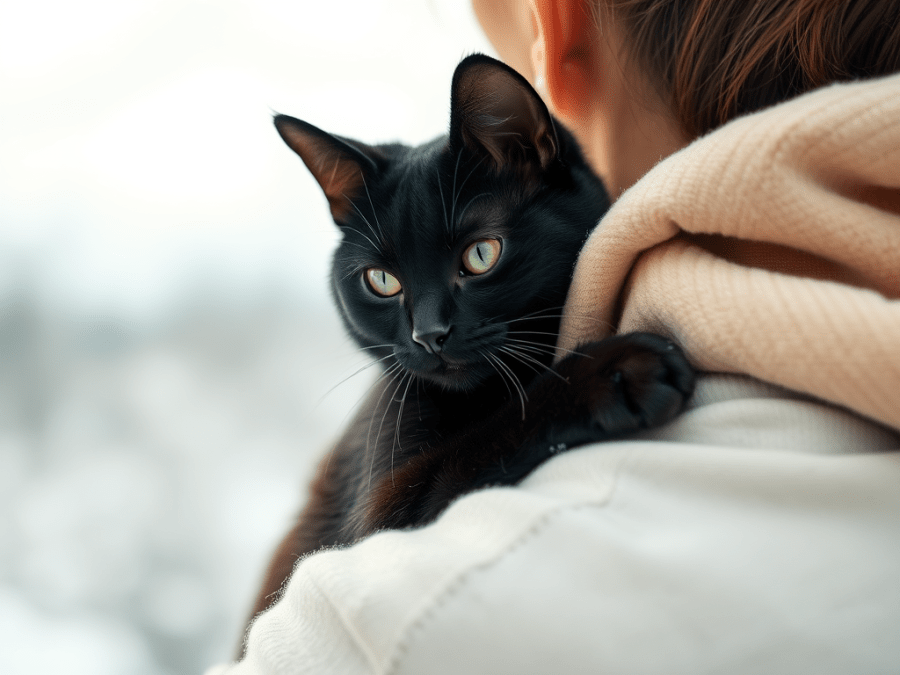
I spot Hershey, my black cat. He is so named because I’m as addicted to chocolate as I am to this demanding fellow. After running to greet me, he claws my yoga pants, insisting I pick him up. I dutifully comply. This cat has inflicted more scratches on my body than all the rest of the feline population on the farm combined. He’s a fierce lover. If he were a man, I’d categorize him as a toxic boyfriend with no husband potential whatsoever.
And yet, I pick him up and cuddle him close. Next to my hoodie, that is, because every time Hershey touches my skin, he gives me poison ivy. So I love him with a layer of fleece between us. He pushes past the fabric and snuggles into my neck, licking my chin. I sigh as I realize this slip will undoubtedly result in a red, scratchy rash by morning. I cuddle him just the same. That’s what love does to a person. All good intentions fly out the window when you’re under its spell.
“What do you do for me, Hershey?” I tease. “I feed you, give you fresh water, and provide you a warm home. And yet, what do you give me? Isn’t love supposed to go both ways?”
He purrs in response, and even though his reply sounds convincing, I know there are no promises behind it. He will undoubtedly leave me. His propensity to cross the road guarantees that. He has no loyalty to me. The call of the wild is too great, and someday, this call will cause his death. One day, Hershey will be unable to cheat the Grim Reaper again. His nine lives will run out as a passing car or truck steals his life.
I’ve been through this twice before. I see the writing on the wall. Eventually, Hershey will go, leaving me heartbroken.
And yet, today, at this moment, I choose to love him. Not because of what he gives me. Not because of any assigned value I attach to the feelings he stirs within me. But, simply because I like being with him.
I carry Hershey over to the wood boiler, scratching his ears and chin just as he wants. He boldly maneuvers his head so my gloved fingers hit the magic spots.
Today, the boiler fan is running, which is a good thing. It has allowed the house temperature to reach 74. It’s about time. Earlier this week, when the daytime high barely reached 20, the fan refused to turn on. This caused what could have been a blazing fire to merely smolder. On those days, my propane furnace turns on out of necessity. It’s expensive to heat with wood and propane simultaneously. I really need to get this fixed.
Hershey jumps from my arms, and I toss half a dozen split logs into the boiler. As the flames consume the dry wood, I hear my two miniature Nubian goats calling. I open the barn door as Sophie runs to the gate separating us. She sticks her head out for me to give her head, her neck, and beneath her chin a thorough rubbing. She lets me know when she’s had enough. I’m not allowed to stop until she does.
Lu-Lu eyes me suspiciously from across the pen. She slowly approaches and nudges my hand. Finding no treat, she saunters away. Lu-Lu has no desire for loving. Food is her only motivation.
I see a correlation between goats and narcissism. They exist for their own pleasure, and I exist for their pleasure. There is no “we” as far as they are concerned. While my romantic notions may convince me they love me as much as I love them, they do not.
The truth is, these goats have done everything they can to make me stop loving them. They use me for what they can get, then abandon me when they have gotten what they want. They don’t listen. Rather, they don’t obey. I’m sure their hearing is just fine.
They unlatch the inner barn door with their lips and hop into the main part of the barn, poop marking their journey. They don’t even try to hide their misdeeds. They don’t care enough to be ashamed.
They hop into the hay loft, tumbling the bales from their stack and scattering disheveled hay everywhere. Then they poop on that, too.
They escape under the fence whenever they find the grass on the other side more tempting. I’m confident the phrase, “The grass is greener on the other side of the fence,” was first spoken by a goat. If they can’t crawl under a fence, they’ll knock it down. No fouls exist in their playbook.
They go out into the road and expect traffic to stop for them.
They eat my flowers and ornamental bushes and fruit trees.
There is nothing they won’t do if an idea pops into their heads. All challenges accepted. And when I slap their behinds with my work gloves, they have the nerve to look offended.
I ask myself why I keep them. The only answer I can come up with is that I just like being around them. When I work in the yard or the barn I enjoy their company. Somehow, their sauntering movements relax me. My affection is not tied to what they do for me or how they make me feel. I simply love them for who they are.
Can the same be said for humans?
When we love a person, what do we typically say?
“I love how he completes me.”
Okay. He completes you, and that’s what you love about him. But what would happen if he stopped completing you? Would you then stop loving him?
“I love him because he’s everything I’ve ever wanted in a man.”
Okay. What if he stops being everything you want in a man? Is there anything to love about him if he stops being everything you want?
These questions were brought to me today in a podcast entitled “Everything They Told Us About Love Was Not True” by Rabbi Manis Friedman. They challenged my thinking. My thoughts went to my animals and I quickly realized I don’t love them for what they add to my life. They are clearly takers, not givers. I keep them because I simply like having them around.
Rabbi Friedman spoke about the failure of marriages to survive the test of time. He claims that love in and of itself is not a good reason to get married since it’s as easy to fall out of love as it is to fall into love. He challenges us to love the person, not what they do for us nor what we get out of the relationship. His reasoning is that if our feelings of love are based on what a person does for us and that person stops doing what we love them doing, then we could potentially stop loving them – as if the act, service, or feeling is more important than the person.
Rabbi Friedman thinks if we love a person regardless of what they give, we can continue loving them even if they stop giving. This is the basis of true love: to love a person regardless of whatever might or might not come along with them.
If I ever remarry, I hope to feel this way. That his presence is the real gift and the sole goal.
This is true for my children and grandchildren. I have often said there is nothing they can do to make me love them more; likewise, there is nothing they can do to make me love them less.
But sometimes, with a mate, we have different rules. We have expectations, and consequences will follow if those expectations aren’t met. What makes things even more complicated is if the expectations change over time. Or if we were certain something was a promise and turned out to be an “if I can” or “if it works out.” (As always, I am not talking about abusive relationships. Those cases call for different rules. I’m speaking about healthy relationships between basically healthy individuals.)
So, if I love someone for what I get out of the relationship, which do I love more? The person or the benefits of the relationship?
You could argue that my animals entertain me, and that is, in and of itself, giving me something. My response is that whatever joy I get from my animals is self-generated. It comes from me, not from them.
I enjoy watching the kittens frolic. They are not putting on a show for my amusement. They are simply having fun for their own benefit. Whatever pleasure I find in watching them comes from me, not them.
When my goats come running as soon as they spot me, it’s easy to interpret that as love. Just like when a child hears her daddy come in the door and she runs to greet him. The child loves her daddy just as her daddy loves her. The feeling is mutual. Human beings may be complex, but animals aren’t.
Animals just want what they are conditioned to expect. My goats come running, not because they love me, but because they hope I have treats in my pocket. It’s self-serving. It isn’t about me. It’s all about them. Therefore, I continue to contend that my animals give me nothing.
Could the same be true for our mates? Is this what Rabbi Friedman was trying to get across? Was he saying that love for our husband or wife should be self-generated? Was he implying it shouldn’t be based on what they do, say, or inadvertently give us? That those things are secondary, not primary?
This attitude would simplify things. If I love my husband for being a provider, but he falls off a ladder while fixing a roof leak, breaking both of his legs, losing his job, and therefore no longer able to provide, does that mean I no longer love him? It goes to reason that if I love him simply for his ability to provide and then he loses this ability, then my love would end. That would require me to either find another reason to love him or I would need to love him simply for being him. The latter is self-generated love. A perceived value I find within myself and then place on him.
This is the type of love God has for us. We can do nothing to earn his love, and once we have been redeemed by His Son Jesus, there is nothing we can do to separate ourselves from it. God’s love is self-generated. It originates from Him.
So, where do we go from here? What conclusions are we to draw?
First of all, I’m keeping my animals. Even though they do not earn their keep, I find value and entertainment in their presence. Therefore, they stay.
I’ll keep my kids and grandkids, too. They are better at earning their keep than the animals, but even then, I cannot depend on them to bring my life meaning and purpose. My happiness and self-worth are not dependent on them, nor should they be. That’s too heavy a burden for anyone to bear. Love for myself and my family needs to be self-generated and self-sustained. I’m responsible for myself, for what I see in the world, and for what I give back to the world.
As for a future husband? Who knows. But if someone special is to come into my life, I want it to be with a man who desires my presence more than anything I could give him. I’m too old for games. I want real and authentic, with a smattering of boldness and vulnerability. I want a man who I simply love to be with.
And who is willing to put up with demanding cats and narcissistic goats. That would be the cherry on top.
 Diane J Mehalic